

Note: This essay contains descriptions of domestic violence, loss, and trauma. Please read with care. Support resources are at the end.
A woman’s feet pound into sand. Her breath tears out of her. She cuts between palm trunks, shoulders clipping leaves. Too fast to feel it.
Behind her, a figure gains ground. In front, bungalows glowing in the distance.
Her foot strikes something sharp. She falters. Winces.
A hand lashes out and snags her ponytail, slamming her to the ground. Her world spins.
A shadow looms over her, swallowing the last of the light. She braces her head with her hands.
Then — voices nearby. Laughter. The figure turns toward the sound. He hesitates. She doesn’t. She scrambles to her feet and takes off.
I
For years, this memory has lived in my body like a scene out of a horror film. Not the kind I watched as a teenager with my face buried in a boyfriend’s shoulder. A different kind of horror entirely. The kind where the monster is real and you are the one running.
Horror films were never something I examined very deeply. I knew them mostly through headlines and shorthand. When I watched them, it was only as an experience to step into briefly — for the thrill of it. I had no idea how much that world would help me understand my own.
That was until I found myself in it.
I was cast in a small independent slasher called Terrifier. Looking back now, how I said yes to the role of Victoria Heyes is a mystery to me.
The earliest exchange I still have is an e-mail with Damien Leone, the director and creator of the Terrifier franchise. It references a great chat and my eagerness to read the script. At the time, Victoria Heyes was one of two roles I was being considered for. The date was April 20, 2015.
They say emotion burns moments into memory. Reading Terrifier was one of those moments.
I remember the visceral sensation of it. A tightening in my stomach. Disgust. A kind of moral vertigo. At the time, I couldn’t quite explain why it affected me so deeply. The initial Terrifier script wasn’t oozing with humor the way the later scripts would. It was quite dark. But I would come to understand that my reaction had less to do with the script and more to do with something in my own life. Something that I had not yet fully acknowledged.
I recorded a video audition, fairly certain that if the part were offered to me, I would turn it down. A few months went by. It seemed I hadn’t gotten the part. I was relieved. The decision had been made for me. Then, weeks later, Damien reached out. He had been pulled onto another project. He asked if I wouldn’t mind re-uploading the tape. More time went by. Another e-mail. This time with an apology for the delay and an offer to play the role. I accepted the next day.
All I have now is the correspondence. Nothing in it explains why I accepted the role of Victoria Heyes — a role I had been certain I would decline. What shifted? What softened since that first read? Maybe it was simply time. The emotion fading into the background. Or maybe sometimes decisions are made for us long before we understand why.
II
Over the next decade, Terrifier grew into a franchise, adding two more films and turning its lead villain into a new horror icon. It found an audience I never expected, and I, for the life of me, could not understand why. So I started asking fans at premieres and conventions, whenever I had the opportunity, how they could love such violent films.
For years, I listened. I accepted what I was told. But nothing penetrated — until 2022, when a woman broke down in tears at the sight of David Howard Thornton, Damien Leone, and me, at a convention called For the Love of Horror in Manchester, UK. I hadn’t witnessed anything like that before. It was shocking. When the woman visited me at my table, I asked her what it was about horror, about these specific films, that moved her. She told me that she was a survivor of domestic violence, that she had almost been murdered by her husband. She eventually got out, and it was horror films that gave her the strength to fight back.
From that moment on, I began listening differently.
City after city. Table after table. I started hearing countless stories from fans who told me that horror films, and these films in particular, helped them move through trauma and grief. In some cases, they even kept their rage at bay.
Some people told me how they related specifically to Vicky. Her innocence, her trauma, and later, her rage. That surprised me. Vicky was a character I loved to play, but in the original Terrifier, I sometimes struggled to connect with her. I began to wonder about her. Whether I was really so far from the girl I began playing almost a decade ago.
III
When I played Vicky, I saw her as someone entirely separate from me. Someone I had to work hard to bring to life. She was a fighter — that much I knew. But ultimately, she was tragic — broken. Sure, we had similarities. She was a student; so was I. She had a sister. I have two brothers. But something in me refused to look deeper. Eventually, after countless stories of survival shared with me, I was forced to confront my own.
Like Vicky, I had been running. Not from a clown, but from the truth of my own violent relationship. Once I saw this, the distance I had placed between us began to collapse.
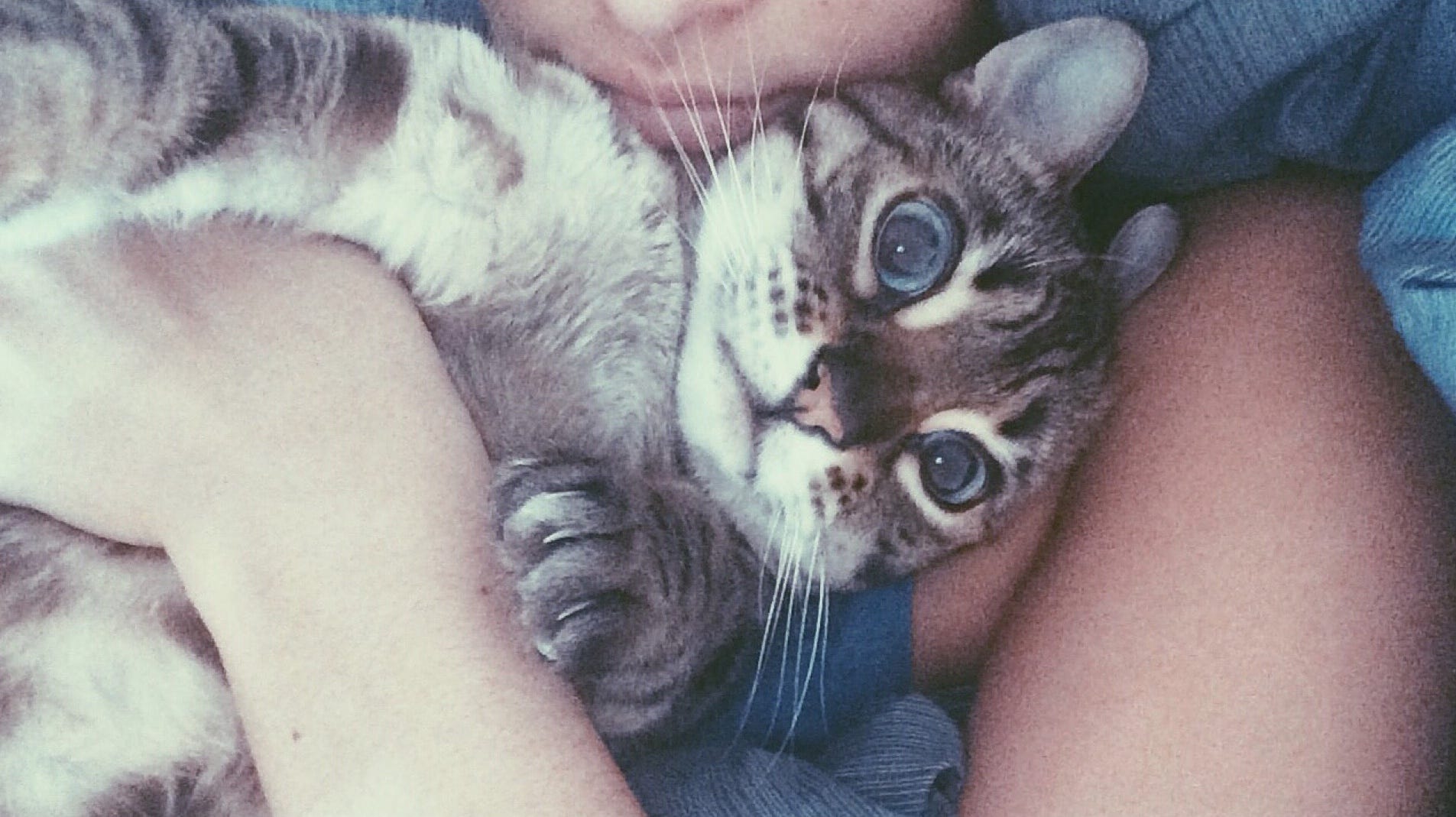
Vicky came upon her sister’s lifeless body. I came home to find Monkey, my blue-eyed Bengal, lifeless in my apartment. I held her small body. Rigor mortis had already set in. Some would say it isn’t the same — a sister and a cat — and of course it isn’t. But grief doesn’t measure itself by logic. That small creature was my baby, my world, my responsibility. She was violently taken from me, and I had failed to protect her. In that moment, something fractured.
Vicky escaped, but she was disfigured. I escaped too. Though my wounds healed, I carried my disfigurement on the inside. Internal, invisible.
In abuse, your sense of self slowly erodes until you no longer recognize yourself. Each time my abuser undermined me, silenced me with his own hands, or made me question my self-worth, another part of me disappeared. Over time, I stopped seeing myself as capable, strong, intelligent — the very qualities my parents had instilled in me. Instead, I began to see the version he had created in me — weak, frightened, dependent.
I had lost a sense of who I was. How could I have let this happen?
Vicky’s mutilation by Art the Clown in Terrifier is a physical manifestation of that same process. The horror version of what abuse does invisibly. Her face, the seat of her identity, is literally taken from her. It is grotesque, but it is also honest about what trauma does. When I watched Vicky again, years after playing her, I realized that she was carrying on the outside what so many survivors, myself included, carry on the inside.
In Terrifier, Vicky is dehumanized, abandoned. During a news interview, she explains that, because of her disfigurement, people are afraid of her, especially children, and that “isolation is ideal.” Monica Brown, the reporter, offers compassion on camera, only to ridicule her behind closed doors.
When Vicky finally lashes out, disfiguring Monica in turn, it’s monstrous, yes, but I can’t help asking myself: Who truly is the monster here? Vicky, in that moment, absolutely. But what about a society that mocked her, exploited her trauma, and turned its back on her when she needed compassion the most?
I’ve experienced the judgment, the quiet ridicule disguised as concern. Often, it came from the very people and systems meant to help. People who lacked the education or the empathy to understand the complexity of abuse.
Like the female filmmaker whose works centered on women’s issues who told a friend of mine that I must have pushed him to his limits. Or the police officer, who told my brother: she didn’t seem threatened enough, when he had asked why my ex wasn’t being arrested after attempting to break into my apartment through a second-story window at 10 p.m. Or the neurologist, who examined a slight hand tremor, turning to me and asking: why did you stay?
In Terrifier 2, Vicky’s story turns supernatural when she inexplicably becomes pregnant with Art the Clown’s severed head and endures a violent birth, leaving her fully possessed. Her glowing eyes signal that something else has taken over. In metaphorical terms, her body becomes the host for the very force that destroyed her identity. She doesn’t create the darkness but inherits it from what was done to her.
By Terrifier 3, nothing of the Vicky we first met remains. She is still there, but something else is driving. In horror, possession taken to its extreme represents trauma with nowhere left to go. When the pain is left unhealed, it doesn’t disappear. It colonizes you piece by piece until it fully takes over.
Years later, my trauma resurfaced without warning as panic disorder, my body trapped in fight-or-flight, with no way to switch it off. I caught a glimpse of what madness could feel like. The loss of control inside your own body. The helplessness. I began to understand how people could disappear inside their pain. I began pushing people away. A slow drift into isolation. I was convinced that this was safety and survival — not a slow poison. For years, I lived behind an invisible veil, becoming very good at simulating connection. Performing normalcy for the outside world but never letting anyone truly in.
But unlike Vicky, I had people who refused to let me disappear. Parents who, when I couldn’t afford it, paid for therapy that freed me from my panic disorder and helped cover the rent on a New York City apartment in a doorman building, where I would be safe and my nervous system could finally rest. A brother who rushed to my apartment the night of the attempted break-in, advocated for me, and took me home with him. Another brother who sat me down during one of my many emotional breakdowns and told me that I wasn’t crazy, that I was strong, even when others were exhausted by me. Both brothers formed a barrier between my ex and me when we went to court to petition for a protection order. And a friend who literally screamed at me, “Let me love you!” when I tried to push her away. That love became my anchor. It kept me from slipping into the same abyss.
Still, I have had to ask myself: Without the people who stood beside me and fought for me, would I have shared Vicky’s fate? For years, I couldn’t find myself in the mirror. Their love gave me the strength to rediscover the part of me that had always existed, the part I had been made to believe was no longer there.
And that was when I finally understood. She was more than a character. Not someone to be pitied, but someone deserving of genuine compassion.
Vicky was me.
What separated our stories was that I was not alone. And that made all the difference in how they ended. In recognizing her pain, I began to have compassion for the person I had been during my own abuse.
IV
I often think about the conversations I’ve had with fans, friends, and fellow artists as we try to understand the violence that permeates our society. So many of these stories, tragic and raw, slip out of view, unrepresented because they are too horrific and painful to acknowledge. And yet, in horror, they find a way to be seen.
I’ll never forget the Sitges Film Festival in Spain. At the opening screening of Terrifier 3 in October 2024, in a sold-out auditorium, I watched a woman in her fifties fist-pumping the air with ecstatic joy as she cheered on Sienna, the series’ final girl, introduced in Terrifier 2 and portrayed brilliantly by Lauren LaVera. Later, when the film ended, a young girl of about ten approached Lauren in tears. She didn’t speak English, but she didn’t need to. Her reaction said everything about how much the character meant to her.
In that moment, I saw two generations, divided by decades, brought together through a shared experience of empowerment. I realized the power of what Damien had created and what Lauren had brought to life: horror, in its rawest form, could inspire not just fear but courage.
I began to see Vicky, the original survivor of Terrifier, as a foil to Sienna. Both women endure horrific violence and loss. Both fight for survival, but Vicky is devoured by the darkness that isolates her, while Sienna, through courage, faith, and an almost spiritual will, becomes the light that confronts it. They are two ends of the same spectrum. One consumed by the wound, the other transformed through it.
What makes Sienna’s victory powerful and profoundly human is that she doesn’t erase the wound; she integrates it. She doesn’t transcend her trauma. She carries it, redefining what strength looks like. This is horror at its height: revealing the light within the dark, the beauty hidden inside the terror.
V
After Sitges, I began watching and reading everything I could find on the horror genre. Old movies, essays, film theory — you name it. And what I found was a depth I had never taken the time to see. An incredible genre I had slept on nearly my entire life.
In Men, Women, and Chain Saws: Gender in the Modern Horror Film, author Carol J. Clover recounts how Alfred Hitchcock, bewildered by the success of Psycho, sought to understand its appeal. Reading her, I began to see that the horror wasn’t simply in the knife but in what it reflected back to its audience: their hidden fears and desires.
Horror invites us to reach. To look into the places we might otherwise avoid. Its power lies in what we bring to it — our interpretations, our experiences, our own survival. For many, it’s a controlled space to confront chaos. For others, it’s catharsis. For some, it’s simply a thrill — a way to feel alive in the dark.
Like Clover, who once wrote about entering horror on a dare, I too stumbled into it by accident — or maybe by fate. She later described her own relationship to the genre as a “conversion narrative.” I’m starting to think of mine the same way.
Sometimes I wonder if I was meant to play Vicky at that exact moment. To embody a woman fighting back, to pour my strength into her, and without realizing it, call it back to myself.
VI
The bungalows in the distance are closer now. She fixes her eyes on Bungalow Six. She can make it. With one last push, she reaches the door, yanks it open, and stumbles inside. But he is close enough to force his way in behind her. Outside, the sun slips below the horizon, the last light bleeding into the sea.
Sometimes I think back to that night. The woman running across the sand toward the bungalows. The idea that if she could just reach one of them, there would be safety on the other side of the door. But the truth is, when she reached it, she didn’t escape. She ran inside and took the violence with her — out of sight of the other guests. Out of sight of the world.
If you or someone you love is affected by domestic violence or sexual assault, you are not alone.
United States
Domestic violence: National Domestic Violence Hotline, 1-800-799-SAFE(7233), or text START to 88788.
Sexual assault: RAINN, 1-800-656-HOPE(4673), or text HOPE to 64673.
United Kingdom
Domestic abuse: National Domestic Abuse Helpline, 0808 2000 247
Sexual assault: Rape Crisis, 0808 500 2222 or chat online at http://247sexualabusesupport.org.uk
If you know a hotline or organization where you live, please leave it in the comments.
I struggle to articulate my thoughts and feelings, and this piece resonates with me so much. Thank you for telling your story 🖤🫶🏻
Hey Samantha,
Thanks for telling your truth. Met you briefly this past weekend at the con in Raleigh. If I could have read this before then, I would tell you thank you for your strength when dealing with the trauma of abuse and kindness you showed to your fans.
As a horror fan, I think you hit the nail on the head. Horror tells stories about serious subjects in fun ways. The beauty in the horror as you said. I always felt the horror community accepts all kinds: the weird, the strange, the unloved, straight, gay, bi, trans, etc. and those looking for a community. All we ask is you enjoy horror, and be kind to those you may not look or think like you do.
Thanks again for the article. Keep being creative and being a light in the darkness.